


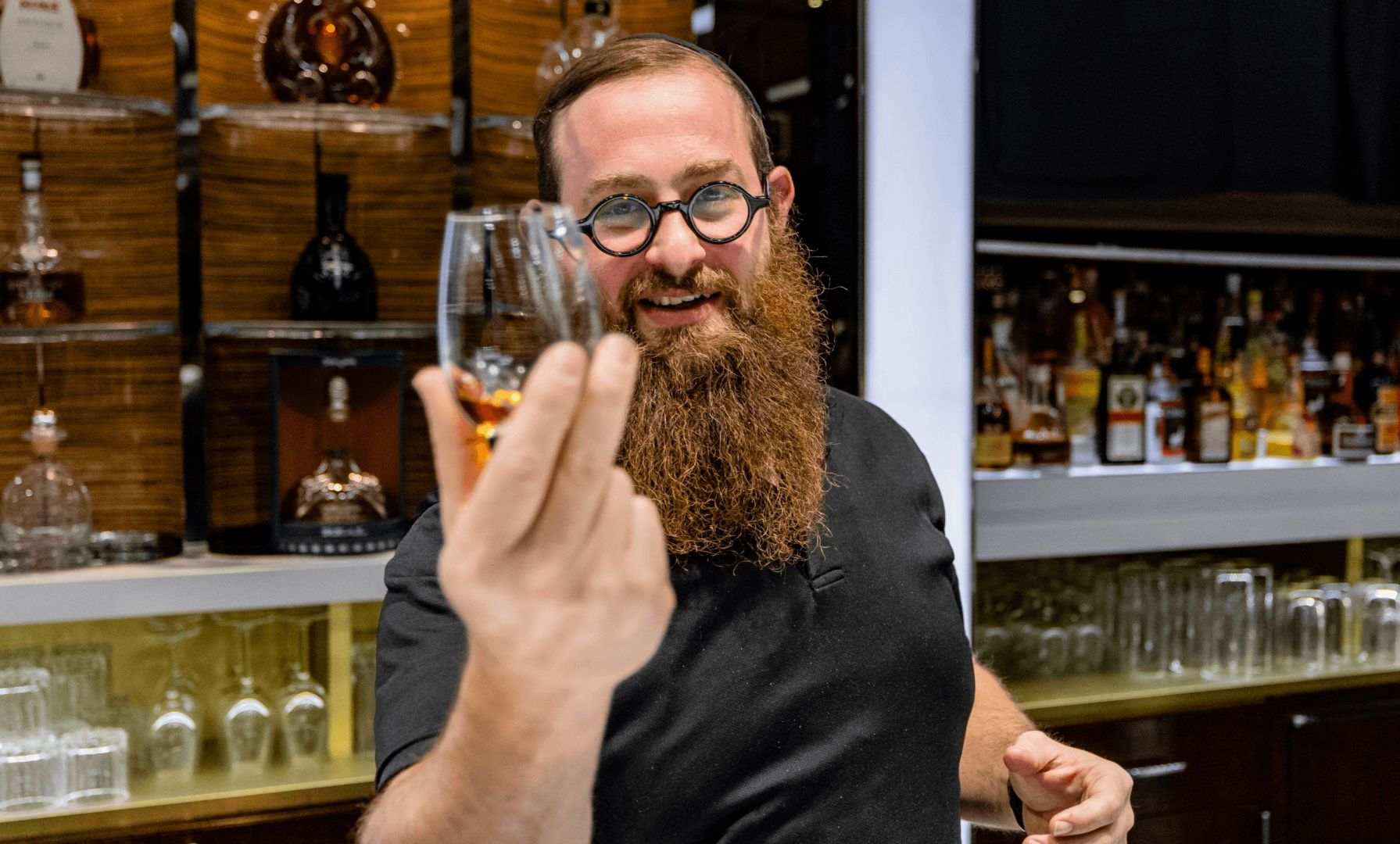
A talk with Rabbi Chaim Litvin about the Jewish connections and the halachic issues of a glass of whiskey
Kentucky. The name itself conjures up visions of racehorses, Kentucky bluegrass—and a certain type of whiskey. You may know bourbon as a stark palate cleanser between the fish and the meat on Shabbos—or something you sip at the Purim seudah—but it’s actually a $9 billion industry strongly associated with the Bluegrass State, although it can technically be made anywhere in the US.
Bourbon is an American-made drink, with its name legally protected in the same way as Champagne. Those who drink it know that its taste contrasts strongly with whiskeys made overseas in places like Scotland. Scotch and bourbon are two very different drinks, even if they start with similar ingredients.
Part of what makes bourbon legally distinct is the requirement that it be aged in new barrels, unlike many scotches that are aged in wine, sherry or even bourbon casks. It is also, surprisingly, a very Jewish drink, with a number of historical distilleries and present ones founded or owned by Jews.
There has long been an assertion that bourbon doesn’t need a hechsher in order to be kosher, thanks to the strict regulations of how it is made, but a recent talk I had with Rabbi Chaim Litvin, who calls himself the Bourbon Rabbi, disabused me of that notion.
Rabbi Litvin’s moniker is not just because he is an expert on the kashrus of alcoholic drinks who has been working in their production for years. He also recently started his own line of alcoholic drinks under the Bourbon Rabbi label, including bourbons (of course), an interesting evolution in his career. In our conversation, we spoke about what it’s like to live in Kentucky as a frum Jew, how he became focused on the kashrus of alcoholic drinks, and how he got involved in making his own. He also gave me a glimpse into the challenges that may be coming for the American alcohol industry as a result of the Trump tariffs.
Down South
One question people might ask is how the very chareidi Rabbi Litvin ended up living down South, and his response is similar to that of many other Chabad shluchim: “My father was sent here by the Rebbe in 1985, so I grew up here.”
My next question, therefore, was somewhat naive: What’s it like living there?
“It’s what I know,” he said. “I went away for yeshivah, of course, but it’s odd for me to be in a city like New York. I know that people assume there would be a lot of anti-Semitism in Kentucky, but I haven’t really seen it. It’s the kind of place where kosher milk and meat are hard to get, so we bring them in in bulk from New York and other places. Minyanim are a little hard to get; we only have them on Sundays, Mondays, Thursdays and Shabbos.”
Chinuch has meant some sacrifices.
“I have a daughter who is away in school; she left when she was 14. I have two more kids going away next year at 13 and 14, so chinuch is hard here. Those are the kinds of things we have to deal with.”
Rabbi Litvin has no noticeable South accent, and I asked him if his children had picked one up. “Not really,” he replied. “I don’t have one and I’m from here.”
He lives in Louisville, the largest city in Kentucky and the historical epicenter of the bourbon industry. I asked him what the nearest city with a sizable Jewish population was. Memphis, Tennessee? I hazarded. But his answer surprised me.
“Probably Cincinnati,” he said. “It’s not a giant city, but it’s much bigger than Louisville from a Jewish point of view. Memphis is probably a five-hour drive, while Cincinnati is only 90 minutes away. Cincinnati has kosher food and a restaurant, and you can get sushi in the local Kroger. They also have a school, a yeshivah and multiple daily minyanim.”
How he first became the Bourbon Rabbi
Rabbi Litvin started doing hashgachah on bourbon and other alcoholic drinks almost 20 years ago, but that was alongside certifying a number of other products. “Before I got more involved in whiskey, I was working for all these kosher organizations doing other things: in a peanut butter factory, a popcorn factory, chips, seeds, nuts and breadcrumbs. I do a lot of general hashgachah. I work with all of the major kosher organizations, doing plants for the OU, OK, Kof-K, Star-K, cRc and some of the chasidishe hechsheirim, and I’ve been doing it for quite some time.”
Then his focus changed around eight years ago.
“In 2017, The Wall Street Journal interviewed me as part of an article on kosher bourbon, which jumpstarted my further involvement. I started giving lectures and doing events around the world.”
Most of his hashgachah work is within a 90-minute drive from his home, which makes him particularly involved in bourbon.
“Bourbon, rye, whiskey—a lot of categories are made here,” he said. “Kentucky makes 95% of the world’s bourbon, so the majority of the whiskey made in distilleries around here is bourbon. But there are many other types of whiskey as well.”
To read more, subscribe to Ami