




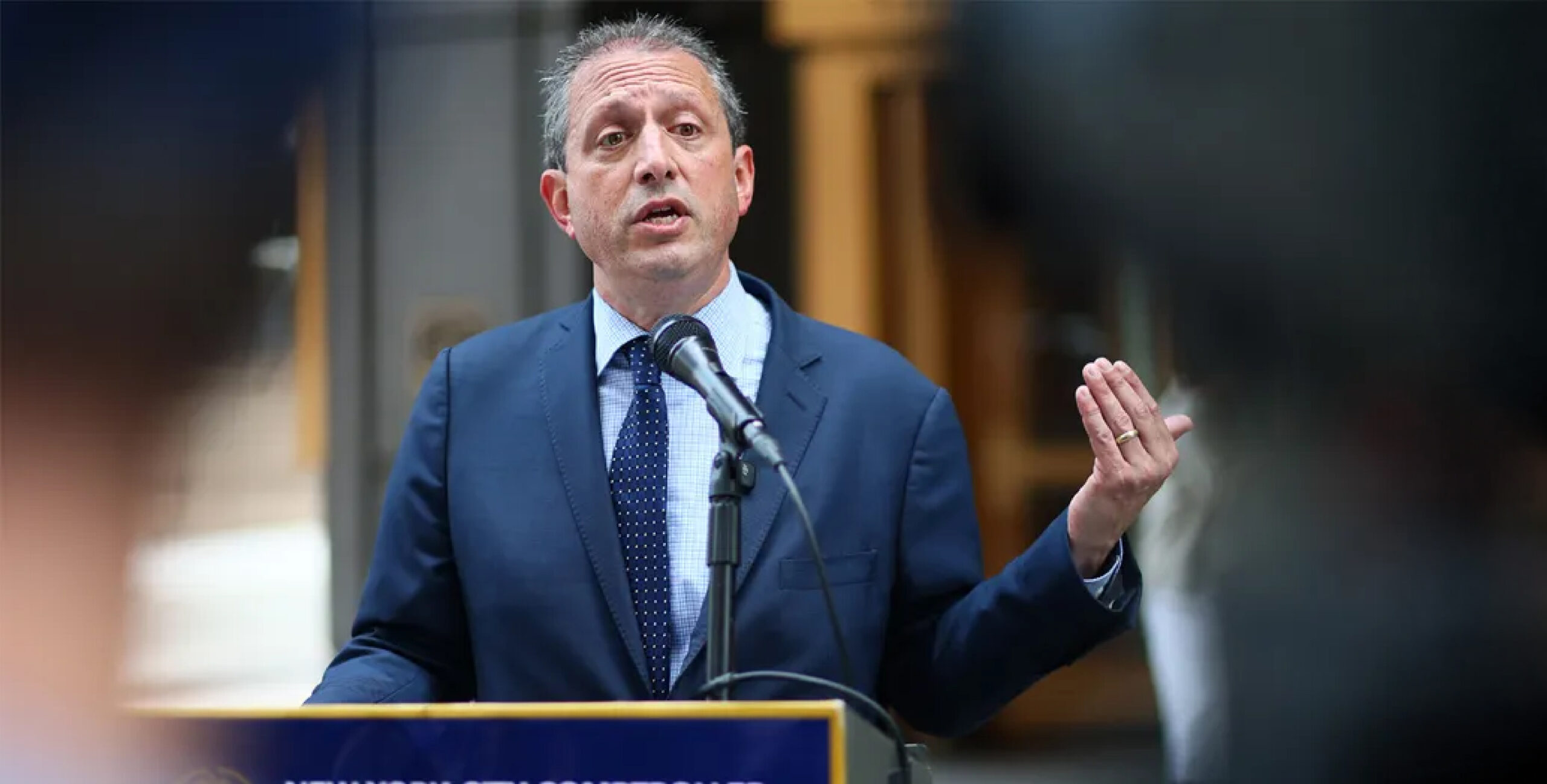
The figure standing behind the podium in front of the mosque prefaced his words with the traditional Muslim invocation: “Bismill-hir Rahmanir Rahim—in the name of All-h, the merciful, the compassionate…” His lilting, slightly off-key rendering echoed throughout the large room.
As mosques go, this was no shtiebel-sized converted storefront where Muslims gather to pray. It was a huge Islamic center located in Jamaica, Queens, infamous for being headed by an imam who denied that the October 7 massacre had taken place and who has called for more 9/11-type attacks on the United States.
If you’re wondering about that figure standing at the podium, it was none other than Brad Lander, the controversial candidate in the upcoming Democratic primary for Congress in the 10th district.
After his invocation, Lander launched into a diatribe against Israel, falsely accusing it of committing genocide in Gaza and adding that he also considered the war against Hezbollah to be turning into a “genocide in Lebanon.” After finishing his remarks, the imam of the Al-Khoei Foundation took over, wailing a prayer calling for “the killing of the kafirs (non-Muslims) by the sword.”
Lander’s shocking appearance at the mosque last month has saddened—but not surprised—many who have gotten to know him over his nearly two decades in elected office. Lander has always presented himself as a proud Jew; he has proudly introduced himself as “Baruch Shmuel” and called himself a “progressive Zionist” whose loyalty to the Jewish community was sacrosanct.
And yet he is now virtually indistinguishable from AOC, Rashida Tlaib and Ilhan Omar, the members of Congress with whom he promises to coalesce if he wins the congressional race this year. The prospect of a strengthened Squad—the so-called caucus of rabid anti-Israel lawmakers, especially with the addition of someone representing one of the largest Orthodox Jewish districts in the country—is horrifying to many people.
Although the Democratic Party has lurched to the left over the past few years, a majority of its lawmakers still profess to care about Israel’s defense. While the Democrats have turned AIPAC—one of the most powerful lobbying organizations in the country, dedicated to strengthening the partnership between America and Israel—into a pariah, they still accept its money through third-party arrangements. These Democrats will issue statements critical of Prime Minister Binyamin Netanyahu and cheer the blacklisting of Betzalel Smotrich and Itamar Ben-Gvir, leaders of two right-wing Israeli parties, but will not vote to cut military aid to Israel.
The rise of Brad Lander’s candidacy, however, threatens to confer mainstream legitimacy on the growing wing of Democrats who are itching to change that. Add the fact that Lander, who once had a reputation as an advocate for yeshivos, has now turned into one of their biggest foes, and you will understand why askanim are calling this the most important election this cycle.
Lander’s opponent, the incumbent Rep. Dan Goldman, has been a relative moderate on Israel, refusing to term Israel’s war on Hamas genocide and helping Americans who were stuck in Israel during the airline closures with passport issues.
The Democratic primary will be held on Tuesday, June 23.
From Uneasy Ally to Unabashed Foe
Lander is one of three Jews who were supportive of Israel but underwent radical shifts when they saw that as a path to higher office. Along with Daniel Biss in Illinois and Scott Wiener in California, the abrupt transfer of allegiance has been baldly opportunistic.
Still, Lander’s behavior is an enigma to many people. To get their take on the situation, I reached out to a number of askanim, community leaders, yeshivah administrators and political activists who remember him from his early days. About half of them responded, most insisting that they would only talk on condition of anonymity.
The majority traced Lander’s change of heart to his ascent in 2021 to the position of New York City comptroller, which was seen as a stepping stone to higher office. Some pointed to an earlier time, when Donald Trump became president in 2016 and Lander’s progressive allies, such as Linda Sarsour, started a campaign protesting the new administration, which also turned into an anti-Israel fest.
“I think it started when he decided to become a progressive, and part of being progressive is being anti-Israel,” one askan with close ties to Lander said. “He was once totally opposed to BDS, and now he’s a fervent supporter of it. He has really gone way, way over to the left.”
As late as 2019, Lander shared a piece by Batya Ungar-Sargon, a right-wing commentator, pushing back on the BDS movement: “Please read this sharp piece by @bungarsargon on why American Jews must oppose BDS-blacklisting legislation,” Lander, then a city councilman, posted. “Especially if (like me) you care about Israel & do not support BDS. We’re acting in ways that threaten to undermine things we love & depend on.”
Compare this to what he recently said in the run-up to a vote at the Park Slope Food Co-op on whether to boycott Israeli products: “Boycotts, divestments and sanctions are legitimate tools of advocacy campaigns. Unlike my opponent, I don’t believe all opposition to Israel is anti-Semitic.”
In 2009, when he ran for City Council in a district that included a chunk of Boro Park, Lander lost that portion of the district by around 90 percent. Nonetheless, he managed to win the endorsement of some Jewish notables, including Dov Hikind, then a state assemblyman and something of a community power broker.
To read more, subscribe to Ami