




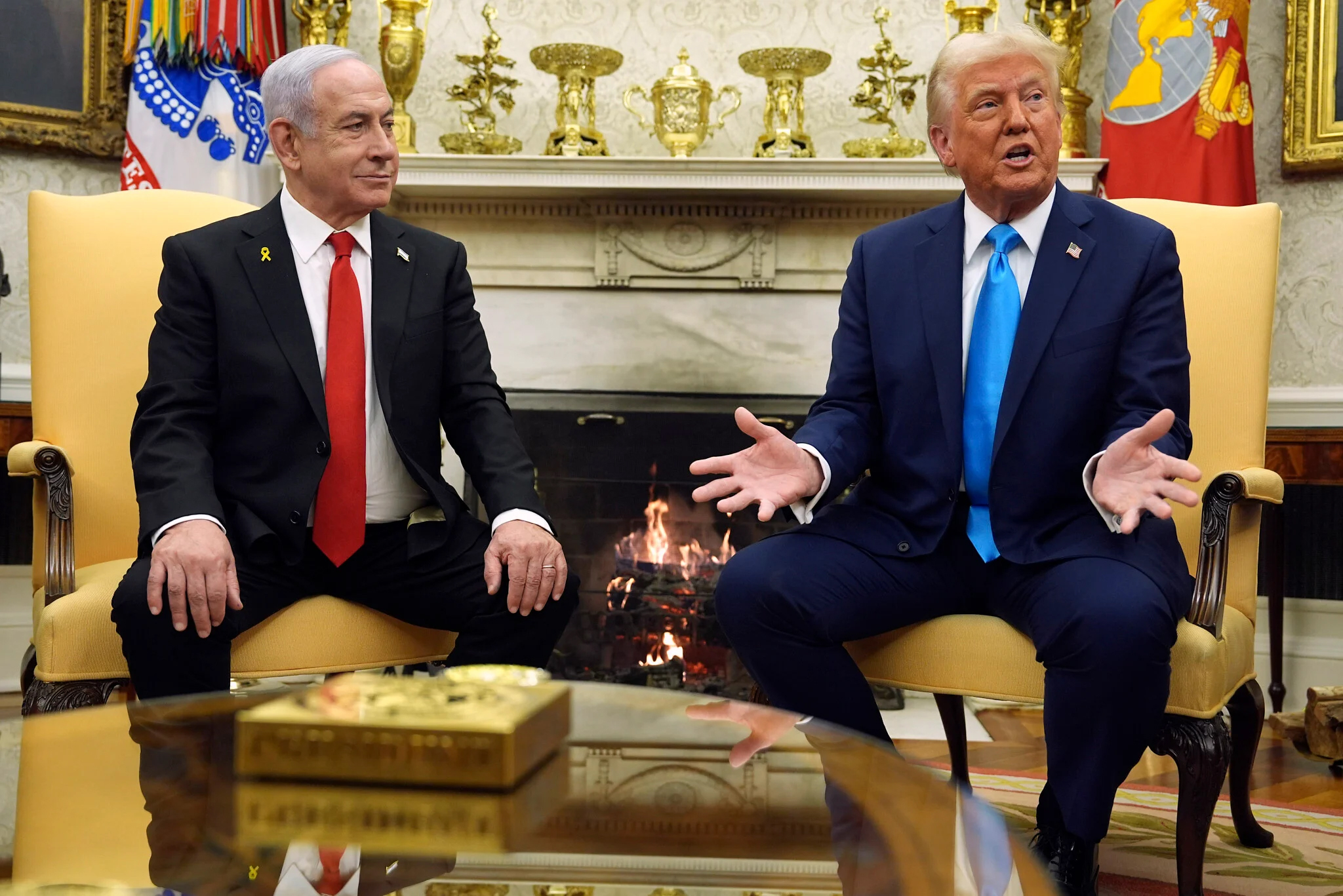
A conversation with Yossi Klein Halevi
Born and raised in Borough Park, Brooklyn, Yossi is an Israeli-based best-selling author, and a leading thinker and commentator on Jewish and Israeli affairs. I spoke to him this past Monday about Netanyahu’s visit to Washington.
The historic meeting with Trump was the most important, the friendliest and the most significant” of any meeting between an American president and an Israeli prime minister, Benjamin Netanyahu told the Knesset on Monday, as reported by the Times of Israel.
That claim came after a remarkable and strange week of which Netanyahu’s visit to Washington, DC, was only one element.
There was the announcement that Trump made about his plans for Gaza. First he made it with Netanyahu next to him, suggesting that Palestinians would be moved out of the Gaza Strip while it was rebuilt and that the US would have an “ownership element.” Did he mean that the Palestinians would be out for good? What did he mean by US ownership?
On Sunday, Trump said, “I’m committed to buying and owning Gaza,” suggesting total ownership—though whom is he planning to buy it from?
Then on Monday morning, an interview Trump gave to Fox News was released, in which he said—contrary to what Netanyahu and Trump’s press secretary had said—that Gazans who left the Gaza Strip would not be allowed to return. “No, they wouldn’t, because they’re going to have much better housing,” he said. “I’m talking about building a permanent place for them.”
Meanwhile, the Israeli public and Jews around the world were shocked by the emaciation of the three hostages released this week. The cruelty of both their condition and the handover (during which Eli Sharabi was put on stage and made to say that he was happy to be returning to his wife and children, while they had actually been murdered on October 7) angered the public, and then the three went on to describe the tortures and ways they had been held.
On Monday, Hamas said that they were refusing to go on with the next hostage release because of what they claimed were Israel’s violations of the ceasefire. As usual, their claims had little merit. Israel had in fact withdrawn from the central Gazan corridor. Hamas accused Israel of firing on Palestinians, but that was in fact only those who had approached the border between Gaza and Israel in the north—something they had been warned about.
Some have speculated that the backlash to the terrible images of the released hostages has caused Hamas to stall.
Meanwhile, Trump appeared to have an effect on another front. Palestinian Authority President Mahmoud Abbas gave an order abolishing the PA’s “pay-for-slay” policy, in which the families of convicted or killed terrorists get special payments—in cases of convictions, they are predicated on the time they spend in Israeli prisons. The PA said that from now on, families of terrorists arrested by Israel will receive payments based on financial need, like other people. According to reports, this move, which Israel has said is a farce, was specifically done in order to try to appeal to Trump, whom the PA felt had ignored them in his first term after they publicly rejected him.
As we go to press, Trump has said that if all hostages aren’t released by the end of the week, the ceasefire should be called off, so understanding his influence and ideas is vital.
It seems almost like v’nahapoch hu. We have a new administration in Washington, DC, which is exceptionally pro-Israel and is taking some very interesting initiatives on behalf of Israel. Do you see it from that perspective?
Trump already proved his friendship in his first term, when he did a series of acts that were unprecedented in terms of friendship for Israel. This initiative, advocating—I’m not quite sure how to even describe his Gaza initiative—is much more complicated from Israel’s perspective. First of all, it’s not going to happen. Let’s put that on the table and make that clear. I’ve been following MAGA social media in response to his Gaza plan, and his base is decidedly unenthusiastic. People were saying, “I didn’t vote for Trump in order to send American soldiers into Gaza,” so he’s already taken that idea off the table. How exactly is he going to get the people to leave when no one wants to take the Palestinians in? Who’s going to take them? Who’s going to move them? It’s one big fantasy.
Yet he seemed to be doubling down on it yesterday when he was asked about it on Air Force One, saying that he’s going to convince the countries to take in the Palestinians. He seems to at least be playing at the mindset that this is doable.
Once he’s already thrown this idea into the ether, he means to own it until it becomes clear that it’s not going to happen. Now, I’m waiting for the Saudis to kick in here. Trump’s real vision is expanding the Abraham Accords to include them and ending the Sunni-Israeli conflict. For the last 80 years, the Arab-Israeli conflict was essentially the Sunni-Israeli conflict. In recent years that has begun to change, and we are now in a Shiite-Israeli conflict. But taking Saudi Arabia out of the circle of hostility against Israel would be one of the most historic achievements in the last eight decades. So much depends on the success of that initiative. Gaza is almost a sideshow, and Trump is going to drop it soon, once it becomes clear that no one is lining up to support this except for the Israeli government. There will be no Gaza Riviera.
You’re saying that Saudi Arabia would be a great accomplishment, but there has never been a war between the Saudis and Israel, even without a peace treaty. Meanwhile, Gaza has been an active warzone almost continuously since 1948.
That’s a good question. Bear in mind that after the Yom Kippur War, the greatest enemy that Israel had was Saudi Arabia. They, with the Gulf States, led the OPEC oil boycott against Israel, which turned us into a pariah in the mid-1970s. There was the Zionism=racism resolution, as well as most of the Third World breaking off relations with Israel. We were really alone because of the Arab oil weapon. The fact that it’s the Arab oil-producing countries that are now the most likely partners for normalization with Israel is amazing, and it’s something we should acknowledge.
So yes, you’re right that Saudi Arabia is not a threat today, but it was not always so, and in fact, in the not-so-distant past, Saudi Arabia was the most anti-Semitic regime in the Middle East by far. The Protocols of the Elders of Zion was an official text in Saudi Arabia. But now, over the last couple of years, the Saudis have been revising their textbooks on Jews and—very cautiously—bringing in experts on Judaism and Jewish history to teach their imams about Judaism and Israel. There’s something extraordinary happening there. The fact that the Saudis, who are the gatekeepers of Islam and the Muslim holy sites are actively engaged in a normalization dance with Israel will have consequences beyond the Arab world and throughout the Muslim world. So this is a great prize.
What Trump has done with Gaza has really thrown a wrench into the Israeli-Saudi normalization process, and I know this firsthand. What worries me is that this fantasy of a Palestinian-free Gaza—and we’ll talk about the moral implications of that in a moment, but the practicality of Trump jeopardizing his own most prized initiative for the sake of a fantasy places a question mark on his judgment.
Now, I was watching Netanyahu’s face when Trump made this announcement, and apparently he caught Netanyahu off guard. My reading of Netanyahu, and I’ve been reading him for many years—too many years, at this point—he was revealing two thoughts. One was “this isn’t going to happen, but it sounds great to my ears,” and the second, more important conclusion that he was drawing was that “this is great for my political longevity, because now Smotrich and Ben-Gvir may well remain in the government even if I do another hostage exchange, because of the tantalizing possibility of mass transfer out of Gaza.”
To read more, subscribe to Ami