



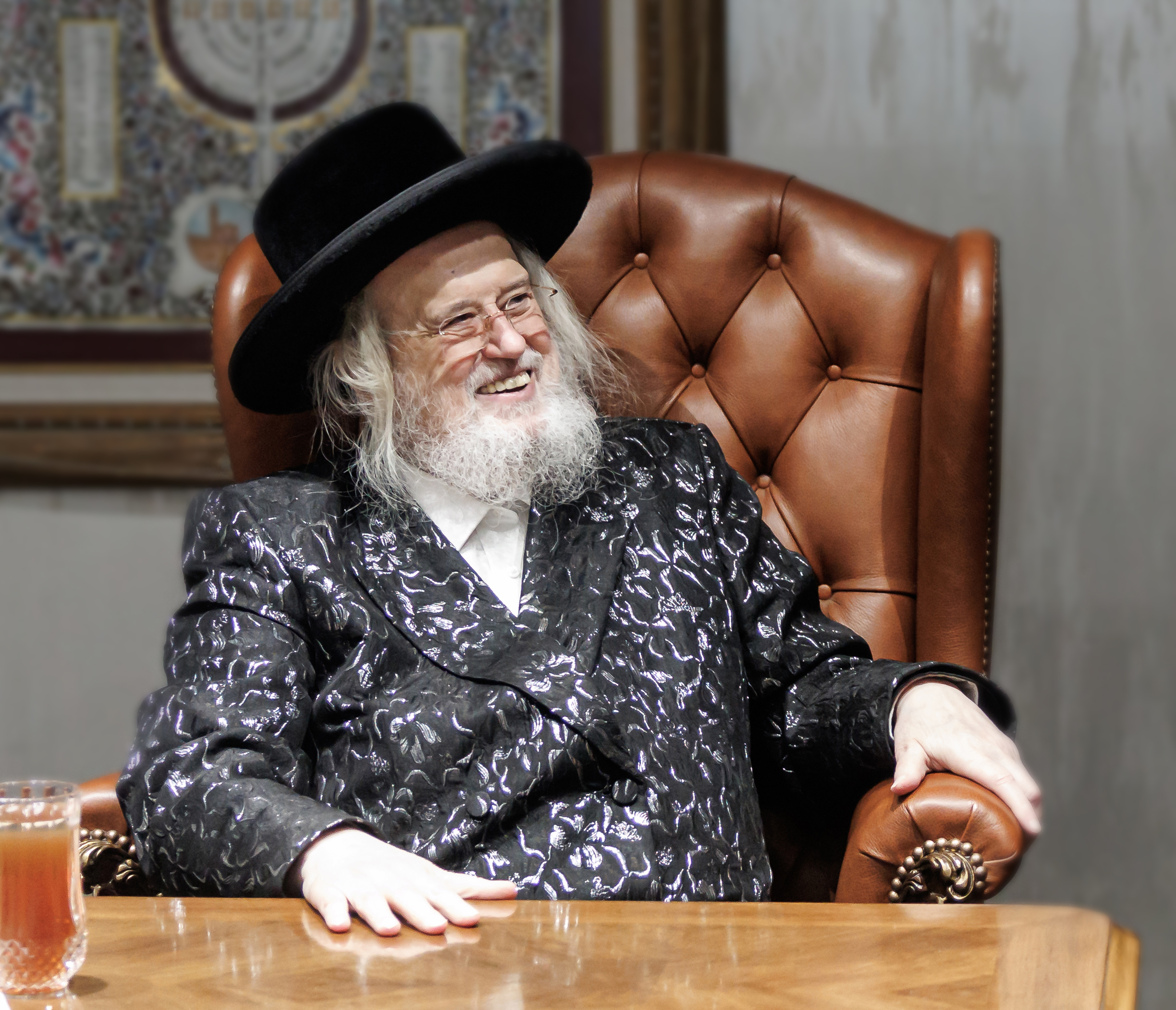
Before Yom Tov, on the occasion of my grandfather’s yahrtzeit, I had the great zechus to pay a visit to the Munkatcher Rebbe and enjoy a lengthy talk with him. Our conversation, which was of course conducted in Yiddish, included private issues as well as devarim ha’omdim al haperek. Also present was the Rebbe’s gabbai, Reb Meir Yosef Frankel.
One of the topics we discussed was Telz, where the Munkatcher Rebbe learned for a number of years as a bachur. In fact, the Rav will be making a visit to Cleveland after Shavuos to mark the 150th anniversary of the Telz Yeshivah. This milestone event will bring together thousands of alumni from around the world to mark a century and a half since its founding in Lithuania. The Rebbe will also attend a special gathering on that day to deliver divrei chizzuk. Among other things, the Rebbe spoke to me about how Telz helped shape his derech halimmud and path in Torah.
As I felt that many of the stories and insights he shared with me would be interesting and instructive to the tzibbur, I sought and obtained permission to publish a portion of that memorable conversation in our Shavuos issue.
Tein l’chacham v’yechkam od—Give to a wise person, and he will become yet wiser.
It’s a big siyata dishmaya to speak to the Rav, as today is my mother’s father’s yahrtzeit. There is so much to discuss. I know that the Rav is being honored by the Telz Yeshivah, which is seemingly unique.
Telz is asking me to come. I never imagined something like that would happen. I was there as a boy. I never expected that they would invite me back to speak. It isn’t easy for me to travel these days, but I’m a baal chov. I learned Torah and grew up there. Now is the time to repay my debt.
Is the Rav going to give a shiur there?
They wrote that I’m going to give divrei chizzuk. When I was in Telz, there was no such thing as divrei chizzuk. Meaning, of course there were divrei chizzuk, but there was the shiur and then there was the shmuess. They were two separate things. But the main thing was the shiur. It seems that nismaatu hadoros, and now the main thing is divrei chizzuk, bringing the chizzuk of the yeshivah of the past into the present day.
How did the Rav originally get to Telz?
My father sent me to learn there. He had various cheshbonos, including the fact that the cook’s husband at Telz was a Munkatcher named Reb Yosef Margulies. This all came about with great siyata dishmaya.
We lived in Brazil at the time. What did we have in Brazil? Nothing. We had a melamed in the afternoon. In the mornings we were in a Jewish school, but we had to learn secular subjects. It was called a talmud Torah. In the afternoons we learned with Rav Stockhammer. My father’s shitah was that sending children away from home isn’t that simple; he felt that going away for yeshivah should wait until the age of 16 or 17, and until then I could stay in Brazil. Meanwhile, mah asah Hakadosh Baruch Hu? There was a big desire to bring my father to New York, but it didn’t work out for whatever reason, so they brought him to Montreal instead. He went there for a Shabbos.
This is all part of Hashem’s wonders. While he was in Montreal, he was invited to test the bachurim of a yeshivah ketanah. Of course, the yeshivah ketanah sent their best students to be tested. The sugya he tested them on was yei’ush shelo midaas in Bava Metzia. [The Gemara discusses a machlokes regarding someone who lost an object but doesn’t know it. Can he be considered to have given up hope of ever finding it even though he isn’t aware that he has lost it, in which case the item can belong to the finder? Or do we say that he cannot be considered to have given up hope, and the finder must attempt to return it.] After testing one bachur on the entire back and forth in the Gemara, my father asked what he thought logically, should it be considered yei’ush or not.
The boy was taken aback by the question, but he thought about it for a few minutes and then said that he thought it shouldn’t be considered yei’ush. My father asked him his reasoning, and he explained that the reason why it would be considered yei’ush is that if he had known he had lost it, he would have given up hope right away, but because he didn’t know that yet, he hadn’t given up yet, and we shouldn’t consider it any other way.
My father liked that answer from such a young bachur so much that when he got into the car when we picked him up from the airport, he told me, “You have to go to a yeshivah. You can’t wait until you’re 16 or 17.” And when I asked him why he had changed his mind, he said, “I just tested a boy in Montreal, and I don’t know if a 13-year-old boy in the heim would have been able to answer that well. It’s clear that there’s no comparison between what we have in Brazil and what there is in America. You have to go away for yeshivah.” Who was the boy? Rav Mordechai Beck, who was a Munkatcher boy and became a great gaon. But my father used him as the basis on which to send me to yeshivah.
I prepared a sugya that I would be tested on. It was a sugya in Perek Lo Yachpor of Bava Basra about a safeik in a case where there is a majority on one side but proximity on the other. I was asked questions about the svaros behind the opinions, but I couldn’t answer them. I’m not embarrassed to say that. I wasn’t used to learning like that. I knew how to translate the Gemara, but I didn’t know how to understand the reasoning behind it.
Now, by the time I went to yeshivah, it was already Chanukah, which was in middle of the zman, because it took time until I got a passport and was allowed to travel to America. The official rule was that any bachur who wasn’t there for the beginning of the zman couldn’t be accepted in middle of the zman, but the hanhalah of Telz decided to make an exception. But I wasn’t sure how well I did on the test. And a test in those days wasn’t the way it is now, where the tester isn’t necessarily an important part of the yeshivah, and sometimes they can ask someone in America to test on their behalf and so on. In those days, the “tester” was the entire hanhalah of the yeshivah listening to the bachur who was being tested.
I left the room so they could discuss my candidacy, and I don’t know what was said at the discussion. But then I saw Reb Yosef Margulies smiling at me. That was a sign that I had been accepted. Then Rav Mottel Katz came out and said, “M’hut aich mekabel geven—we accepted you into the yeshivah.” He used the term aich [the formal way of saying you, generally used as a term of honor], even though I was only 13 years old. That was the Litvishe nusach. “But,” he said, “before you enter the yeshivah, I have to give you a few words of introduction.” This introduction is still inside my bones.
“You know,” he said, “we’re from Lita. Telz was just a small village in Lita. The reason why Telz became known was because of the yeshivah. The yeshivah needed money, so from time to time I would go to New York to collect money. When I would go, I was told that I can’t just go to chasidishe balebatim to ask for money. I have to go to their rebbe first, and once the rebbe will give a few nice words, the chasidim will help me. I asked who the rebbes are in New York, and I was given a whole list. The problem was that I had never heard of them. That wasn’t because of any deficiency of theirs; I simply came from the small village of Telz, where I never heard of anyone. But Munkatch we did know about.
To read more, subscribe to Ami