




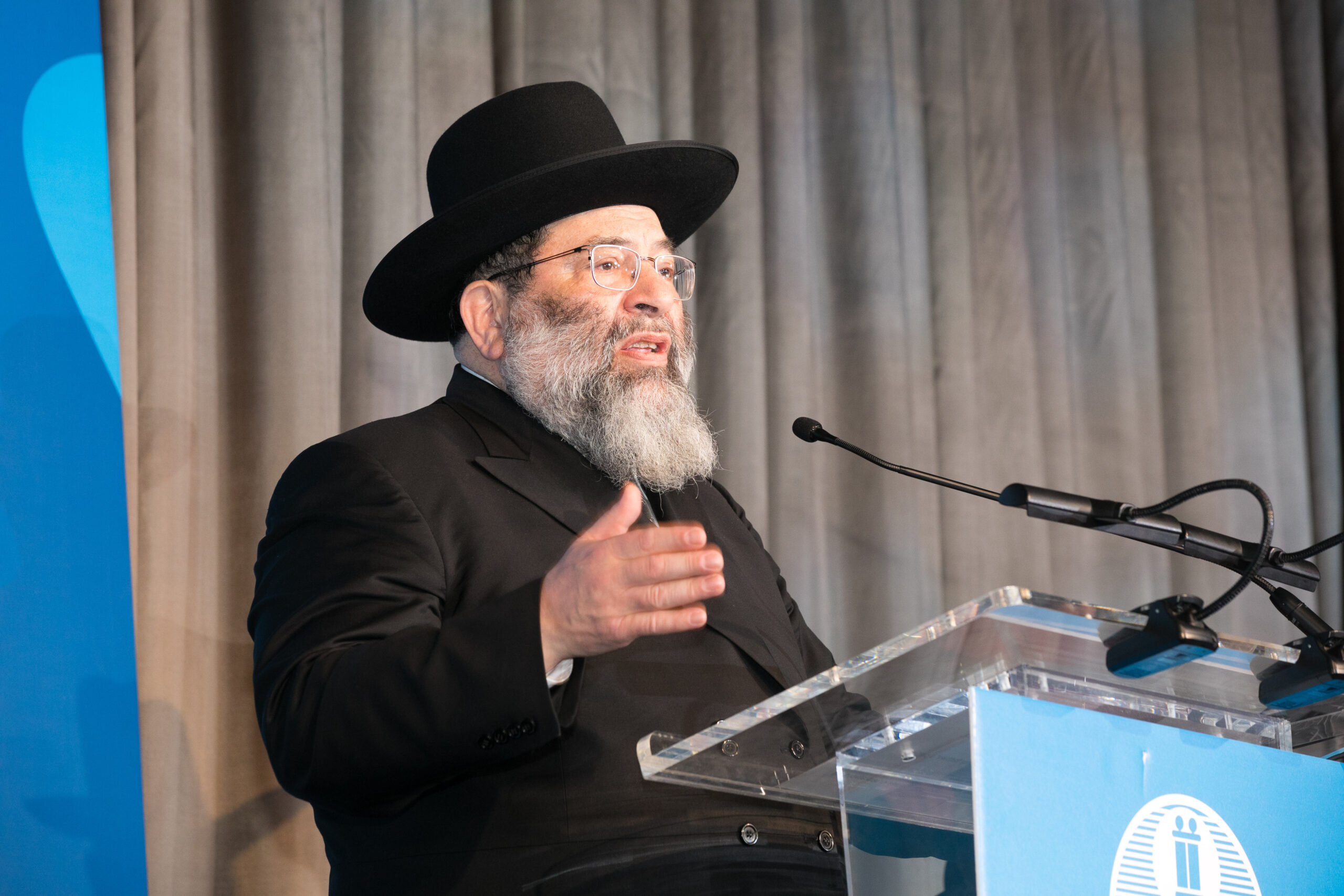
Rav Yaakov Bender, the rosh yeshivah of Yeshiva Darchei Torah, located in Far Rockaway, New York, is one of the most renowned and revered contemporary Torah authorities and communal leaders, both in the Far Rockaway/Five Towns area and in the wider Jewish world. A master mechanech and a confidante of the gedolim of yesteryear, his opinion on matters concerning education is highly respected, and the policies and practices he put in place in Yeshiva Darchei Torah are seen as revolutionary and exemplars for other Torah institutions and schools to follow.
He has also been the driving force behind some of the most important communal institutions in the Far Rockaway/Five Towns area, including the local branch of Hatzolah and the community service organization Achiezer, headed by his son Boruch Ber, which has provided vital medical and support services for Jewish communities in the wider New York area and across the country. Rav Bender’s own activities of chesed for countless people in need are legendary, even as they are usually done in complete secrecy.
Rav Bender recently released a new sefer, Rav Yaakov Bender on Chumash: Classic Torah Insights and Inspiring Stories of Gedolei Yisrael from a Beloved Rosh Yeshivah, published by ArtScroll/Mesorah. I met with Rav Bender to discuss the new sefer as well as his fascinating life story.
I had the opportunity to peruse your chashuve sefer, Rav Yaakov Bender on Chumash, which was just published by ArtScroll.
I’ve been writing a sefer on Torah in lashon kodesh for five years. Reb Gedaliah Zlotowitz found out about it and asked me to make one in English.
I saw that the haskamos were for the lashon kodesh version. Will that one be similar?
Yes, but lengthier and deeper, and it will also have much more material on each parshah. I’ve given nearly 750 shmuessen in yeshivah. The sefer is mostly my shmuessen, with some new machashavos.
Is this your first sefer?
No. I’ve written several sefarim on chinuch. I also commissioned and helped author a book about my parents entitled A Tale of Two Worlds. My parents were the central focus, but it was really about a lot of the people with whom they came into contact before and right after the war, in both Europe and America. I consider this latest book to be a chinuch sefer as well. Everything has a lesson. People have told me they like to use it for a dvar Torah at the table because it has things they can give over to their kids that will leave them with a mussar haskeil. A father can teach a middah at the Shabbos seudah with something from the parshah and a story.
The stories all have gedanken that are built up very well. I also see that you try to capture the flavor of a shmuess.
I tried. I hope it turned out well. I’m starting work on another one right now.
It’s fantastic.
This sefer gives me nachas. There’s a limmud on every single parshah and it’s a davar hashaveh l’chol nefesh, containing something for everyone. It’s a shmuess for adults, many of which I heard from my rebbeim, but it can also be given over to kids.
You said that this sefer is really also about chinuch. I’ve seen from your past writings that you believe very strongly in “chanoch lanaar al pi darko,” that every child needs an individual approach. How do you accomplish that with a sefer, when you’re speaking to the tzibbur and have to relay a general message?
It’s not a contradiction. Everyone can take away whatever he wants. “Chanoch lanaar al pi darko” means that every single child can make it. I really believe that. I have bachurim who came in shvach and are now geonim. I also set up a vocational program in the mesivta for the bachurim who aren’t able to study all day. Later on, they’re happy balebatim.
So your message is to never give up.
Never.
I see that you base a lot of your insights on stories, so I’d like to share a story that the Munkatcher Rebbe told me. I’ve written about it before, but I think it may have relevance to your life experience and mission.
The Rebbe told me that he was once at a bar mitzvah of a yasom in Boro Park, where the Satmar Rebbe, zt”l, was a guest. From the moment the Satmar Rebbe arrived, the photographer kept snapping pictures of him. He would cover his face, and it was making him very upset. He got more and more agitated until he finally said, “Everyone else is allowed to sit in peace, and I am the only one being disturbed.” It was a Motzaei Shabbos during one of the weeks of Shovavim, and he said that the Rebbetzin had asked him not to go because he was tired, but he was matriach to come anyway. Eventually he stood up, asked his gabbai Reb Yossel Ashkenazi to give him his coat, and he walked out.
The Munkatcher Rebbe related that as he was watching them walk out, he saw the gabbai whisper something to the Satmar Rebbe. The Satmar Rebbe immediately calmed down, turned around and sat back down. When the Munkatcher Rebbe asked the gabbai what he’d told him, he replied, “I told him that the bar mitzvah bachur is a yasom.”
That’s certainly a story to which I can relate. I remember the Satmar Rebbe very well. He came to my father’s levayah even though he very rarely went to funerals.
How did the Satmar Rebbe get to go to your father’s levayah?
My father started out as a maggid shiur in Torah Vodaas. Torah Vodaas was across the street from the Satmar Rebbe’s house, so he knew my father. Rav Moshe Aharon Stern of Kamenitz used to say, “When I went into Rav Dovid Bender’s shiur I was a Yankees fan, and when I came out I was a ben Torah.” Rav Yankel Schiff was in my father’s shiur as well.
My mother told me that my father would ask the bachurim a question every Friday, and that night they would come to our house for some cake and soda and discuss the question. One week there was a massive snowstorm so no one came. A short time before midnight there was a knock at the door; it was Yankel Schiff. “Rebbe,” he said, “you asked a question in the morning, and I have an answer.” My father told my mother afterwards, “You’ll see, this one’s going to be an adam gadol.”
Then Rav Reuvain Grozovsky took my father out of the shiur and asked him to be the menahel of the junior high, because a lot of its graduates were going to public school for high school, and Rav Reuvain wanted him to be mashpia on them to stay in Torah Vodaas. Rav Shraga Feivel Mendelowitz made a huge chiddush when he opened the mesivta. Up until then there were almost no frum high schools. He’d opened the first mesivta in 1926, but even in the 1940s the kids were still going to public school. My father wasn’t excited about the change because he loved giving the shiur. At the time, Rav Pam was the ninth-grade rebbe; my father, the tenth-grade rebbe; and Rav Baruch Kaplan taught the 11th grade.
The Satmar Rebbe also knew about my mother because she gave kallah classes to all the Satmar kallahs as well as review classes to the married women. She also used to speak to the Litvishe and Lubavitcher women and went to Crown Heights once a year. I remember her going to the Satmar Rebbe to ask about shidduchim. We knew the Rebbe well.
I didn’t see any stories or quotes from the Satmar Rebbe in your book.
That’s because I didn’t really hear any Torah directly from the Satmar Rebbe. But I do have some things from Rav Yonasan Steif, who lived right across the street from us on Hooper Street. Whenever he went down the stairs my mother would tell us, “The tzaddik is leaving now,” and we would go to watch him. In 1947, when he came out of the DP camps, he made 1,000 shidduchim. He asked my mother to teach the women the halachos. She spoke for three hours. After she finished, they asked her to go behind the curtain on the stage, and she saw Rav Yonasan Steif sitting there. “I listened to the whole drashah,” he said. My mother told me afterwards that she almost fainted. Then he said, “Every halachah you taught was correct. You should continue teaching.” She was basically the only kallah teacher until the 1960s.
How did she get into that?
My father’s closest friend was Rav Shlomo Heiman. They were chavrusos, and he would prepare the shiur with him. In 1941, the two couples went to Sea Gate for the summer together. My parents didn’t have children for nearly five years, and Rav Shlomo never had any kids. A short time later, Rav Baruch Kaplan traveled to Sea Gate and begged my mother to come back. He had just met a man whose daughter was getting married in nine days, and she still didn’t know any of the halachos. She was my mother’s first student, and from then on she was a kallah teacher. She taught them in the house, and we weren’t allowed to go downstairs while her sessions were in progress.
I also remember the Munkatcher Rebbe in Williamsburg. Our family lived on Hooper Street and later on Hewes Street. The Munkatcher lived on Hooper Street before he went to Telz. He’s around ten years older than I am. Whenever he comes to Lawrence I go to see him. And the Klausenburger Rebbe lived right under us. I remember him before he moved to Eretz Yisrael. We pronounced Hewes Street “Hevesh Street,” because that’s how you would say it in Hungarian. That’s where the two present Satmar Rebbes lived with their father, the Sigheter Rav, zt”l,
The reason I told you the story about the Munkatcher Rebbe is that while I was learning your sefer over Shabbos, I came to the realization that someone who is a yasom remains a yasom, regardless of how many years have passed.
Yes. I try to help yesomim as much as possible for that reason.
Was your father ill before he passed away?
No. He had a sudden heart attack.
Without any warning?
I think he had chest pains, but they didn’t have the diagnostic tools that they have today. They just took a cardiogram and it was fine. When my father passed away I was learning in Philadelphia, as I had left Torah Vodaas to go out of town when I was 15. I was in Philadelphia for only a month before he was niftar. The two roshei yeshivah, Rav Elya Svei and Rav Shmuel Kamenetsky, both accompanied me to the levayah. They were close to my father because he helped them a lot by sending bachurim to Philadelphia. After my father was niftar, my shvugger, Rav Chaim Epstein, zt”l, told me to stay with my mother. Going to Philadelphia was like getting into Harvard, but I had to come home after a month. But my mother became my best friend. And I remained very close with Rav Elya and, yblc”t, Rav Shmuel. I’m still very close with Rav Shmuel. I would call Rav Elya, Rav Shmuel and Rav Pam with all of my shailos in chinuch.
Losing your father at such a young age must have affected your whole outlook on life.
Absolutely, and especially in regard to yesomim, which is why I try to help yesomim and almanos. My mother was an almanah for much of her life. She was the first Bais Yaakov teacher in America under Rebbetzin Kaplan, and I learned a lot from her.
I slept in my mother’s room. My mother didn’t sleep very well because she had what today would be diagnosed as sleep apnea. She’d wake up in the middle of the night saying she couldn’t breathe, so I’d sit and talk to her for much of the night. Of the last ten Yom Kippurs of her life, I spent five of them with her in the hospital or at home. There couldn’t be a better Yom Kippur than that.
You weren’t just a yasom, you were also a yasom who was taking care of an almanah.
Yes, but it was wonderful. I had a tremendous relationship with my mother. I was very close to her. She was very special.
Are you the oldest?
No. I was a middle child. But Rav Chaim Epstein chose me to stay home with my mother. My three brothers all went to learn out of town. I went to the Mirrer Yeshivah on Ocean Parkway in the morning and came home at 11:00 at night, and I was home every Shabbos. Everyone went home for Shabbos from Mir in those days.
They had extremely chashuve roshei yeshivah.
It was a tremendous yeshivah. Rav Shmuel Berenbaum and Rav Shmuel Brudny were geonei olam. I was very close with them and they were very nice to me. By then there weren’t that many yesomim because it was a long time after the war, in the ’60s and ’70s. The yeshivah was in its heyday. There must have been 20 future roshei yeshivah in our shiur. I was privileged to be there for 14 years. Rav Shmuel Berenbaum was the koach of the yeshivah, Rav Brudny was the maggid shiur, and the mashgiach, Rav Hirsh Feldman, gave the shmuessen. I tried to pick up Rav Shmuel Berenbaum’s style. He focused on limud haTorah and middos, and that’s what we try to do in the yeshivah. It’s not a stirah to Torah. It’s the foundation.
At one point I was in kollel in Mir, and I remember Rav Shmuel Berenbaum. He had a lot of pashtus.
Exactly. As an example, no one walked him home. He walked home himself. There was no tzimmes whatsoever. He was just a regular person.
And he sat all day in the beis midrash with a shtender and a chavrusa.
Yes. But he also ran the yeshivah and he gave us shmuessen. He would take a Rashi and build it up, which is what I tried to do in my sefer. For example, Rashi says that the reason they were called “avnei miluim” is that they were stones of filling. Rav Shmuel asked, “That’s a compliment? Fillings? Call them diamonds or pearls. Why are they named after the setting in which they were placed? Because as great as a diamond is, it is that much greater if it fills the needs of someone else.”
Just like Rav Chaim Shmuelevitz, Rav Shmuel was both a lamdan and a baal mussar.
Exactly. Rav Sholom Schwadron also made a deep impression on me when he came to America.
He was very dramatic.
Yes. He drew you in; he had a koach. And you could see that his whole heart was in it. During my year of aveilus I became very close to him and followed him around with a big tape recorder. One time he told me that he wanted to give a drashah in Williamsburg, so he asked me to hang up some signs. There weren’t any copy machines in those days, so I sat up all night making signs on oaktag with Magic Markers saying that the Maggid of Yerushalayim was going to speak. I put them up everywhere, but very few people showed up. He was very upset because he’d come to raise funds. After a half-hour of complaining he said, “One second, you people are here. Why am I kvetching to you?” Then he turned to me and said, “What I just did wasn’t nice. To make up for it, I’m going to tell a story that I never told before.” Then he related the now-famous story about Yankel the moser.
Can you share the story in short?
The Kelemer Maggid used to travel from city to city, but on Fridays he would stop at 12:00 noon no matter where he was. One week, when he wanted to climb down from the wagon at 12:00 the wagon driver said, “Rebbe, you can’t get off. It’s a three-hour walk to the next town.” But he didn’t care and he walked there. He approached the first Jew he saw and said, “Shalom aleicheim. I’m a maggid, and I’m going to be staying here for Shabbos.” Then he started asking about the place and it turned out to be a wonderful town. They had everything from a chevrah Shas to a gemach to a chevrah kaddisha and a bikkur cholim. When he asked if there was anything that needed fixing, the man told him that there was one guy named Yankel the moser, who was a terrible person. He informed on people and was also randomly violent. So the Kelemer Maggid asked if he had any redeeming qualities, and the man said that he always keep his word; if he said that he was going to ruin someone, he did it. The Kelemer Maggid then asked if he could introduce him to Yankel, but the man said that he was too afraid.
Just then, he saw Yankel the moser coming down the hill, so he pointed him out to the Kelemer Maggid and ran away. As soon as Yankel was within hearing distance the Maggid said, “Shalom aleichem, Reb Yaakov,” and he kept referring to him as Reb Yaakov. After a few times of being addressed like that he started liking it, so he asked the Kelemer Maggid what he wanted. “I’m a traveling maggid,” he began. As soon as Yankel heard that he said, “Leave me alone,” but the Kelemer Maggid persisted. “Look, I’m giving a drashah in the shul, but no one is going to come.” This wasn’t true because he was very famous throughout Lita. “Do me a favor. Come to my drashah. People make donations to the maggid at things like this, and I really need the parnasah. If you come, people will follow your example.”
As Rav Sholom Schwadron told it, Yankel gave the Kelemer Maggid a “Russishe mi shebeirach,” and then he said, ‘I’m not Reb Yaakov, I’m Yankel the moser. I’m not going to any drashos.” But the Kelemer Maggid had a golden tongue, and he kept talking to him until he convinced him. A few minutes later he changed his mind, but the Maggid said, “I heard that you always keep your word, so you have to show up.”
The drashah was scheduled for 7:00 on Sunday night. The shul was packed, but the Kelemer Maggid just sat there and refused to begin. In the meantime Yankel was going through a war between his yetzer hara and yetzer tov over whether he should go or not. It wasn’t until 8:30 that the door swung open and Yankel finally walked in. The Kelemer Maggid ran to the back of the shul to grab him before he could change his mind, and he brought him to the front and sat him down.
He started off with the Mishnah that says that all Yidden have a cheilek in Olam Haba, and he spent three hours describing it. Then, when he saw that Yankel was warming up and getting excited, he said, “But does everyone really have a cheilek? What about Yankel? Yes. He too has a cheilek. But how? He doesn’t have any zechusim. So I’m going to give him my cheilek. Yankel, do you want it?” Yankel replied, “Of course I want it.” They brought in a sofer to write a shtar saying that he was giving his Olam Haba to Yankel, and Yankel put it in his pocket. Then the Kelemer Maggid said, “Yankel, I’m giving you a gift; make sure to take care of it.” Seventeen years later—Rav Sholom said he didn’t remember if it was 12 or 17, but he liked 17 better—the Kelemer Maggid was passing by the town and made inquiries about Yankel the moser, but no one knew whom he was talking about.
Finally, he found one Yid who figured it out, but he explained that he was now known as Yankel the tzaddik, because after the Kelemer Maggid left he sat there and cried for three days straight. At first, people thought it was just shtick, but he had basically spent the intervening years in shul; the nashim tzidkaniyos would bring him food every day, and they came to him for brachos. Hearing that, the Kelemer Maggid asked that the entire town drop whatever they were doing and assemble in the shul.
The word went out, and the shul was soon packed. The Kelemer Maggid began with the last Mishnah of Yoma, which says that Yom Kippur doesn’t atone for aveiros shebein adam lachaveiro until the person asks his friend for forgiveness. Then he turned to Yankel and said, “How can you be called a tzaddik? How much suffering did you cause, and how many people did you have thrown into jail or killed? You’re a rasha!” Yankel started to fall apart and the townspeople were shocked. “Rebbe!” they cried. “You can’t do this to him.” But the Kelemer Maggid wouldn’t stop. He said, “You have to ask mechilah, but how can you ask mechilah from all the people who are no longer here?” Then he said, “You know what? Since everyone is here in the shul anyway, you can ask mechilah from the entire town. Do you want to do that?” Yankel couldn’t even move, and they had to carry him up. He said, “I, Yankel the moser, ask mechilah from the entire community.” The Kelemer Maggid then kissed him on the head and said, “Now you’re Yankel the tzaddik!”
When Rav Sholom Schwadron spoke, you were putty in his hands. He was wonderful.
And you were traveling back and forth every day from Williamsburg in those days.
Yes. My mother was a Holocaust survivor, and if I wasn’t home by 11:15 she would already be outside looking for me. Sometimes she’d say, “Yankel, I almost called the police!”
You were very selfless.
Not at all. As I said, it turned out to be the greatest thing in the world.
Your mother was really dependent on you.
My whole hadrachah in chinuch comes from her. She never gave us a potch. She’d say, “Yankel, I’m disappointed in you,” but she never got angry at us.
I assume that she was teaching in Bais Yaakov during that time.
Yes. She taught for 60 years. She was often sick, but she had a brachah from the Imrei Emes. The Imrei Emes had a granddaughter who went off the derech because of Haskalah, so he went to Sarah Schenirer’s school and asked them for one of the teachers to work with her. They chose my mother. This granddaughter lived in my mother’s house for six months and my mother brought her back. Sadly, she was later killed by the Nazis.
Where did your mother live in those days?
In Otwock, Poland [a suburb of Warsaw]. My parents got married in 1938, and this was in 1934 or ’35.
Your mother was from a Litvishe family, though.
Yes; she was originally from Minsk. The Chofetz Chaim once used her room for six weeks.
Then I guess she went to Krakow to learn with Sarah Schenirer.
Yes, in 1932. My father was learning in Mir, and someone made the shidduch. They were married in Warsaw. My mother was a very learned person. The Imrei Emes wrote her a letter, but she lost it while running away during the war. In the letter he promised her arichus yamim, which was fulfilled, although she suffered from a variety of health issues her whole life.
What was she sick from?
A heart condition and cancer. When she was 73 years old she was in the hospital and suddenly fell off the bed. I saw that she wasn’t breathing and I called for the doctor. They called a code and brought her back, but then they took her to the ICU, where she remained in a coma for nine days. On the eighth day, my brother Paltiel said, “What’s with the brachah of the Imrei Emes? She’s only 73.” So I called the Lev Simchah, who was the Gerrer Rebbe at the time, and the rebbetzin answered the phone. I told her the story, and she told me to hold on while she spoke to the Rebbe. What happened next is that the Rebbe sent out a minyan to the backyard, where the Imrei Emes is buried because he passed away during the War of Independence. The next morning my mother came out of the coma, and the doctors couldn’t understand what happened. She lived for another ten years, until she was 83.
The Imrei Emes was a very big fan of Bais Yaakov.
My mother arrived here on Erev Yom Kippur 5700 [1939]. They escaped on September 1, the day the war broke out, and they had amazing nissim. My grandfather had a police car waiting for them at the pier. My mother arrived in Williamsburg ten minutes before Kol Nidrei. On Motzaei Yom Kippur, Rebbetzin Vichna Kaplan told my mother, “I’m starting a Bais Yaakov on Isru Chag Sukkos, and you’re going to teach in it.” My mother didn’t know a word of English. She spoke seven languages, but English wasn’t one of them. So she started teaching eight girls in Rebbetzin Kaplan’s dining room. One of the open nissim of Bais Yaakov of Krakow was that four girls either married Americans or were Americans or Canadians themselves. The rest were all killed. These four women were the first teachers in the Bais Yaakov in New York: Rebbetzins Kaplan, Pincus and Wachtfogel, and my mother.
Williamsburg was full of Holocaust survivors in those days.
When I needed a minyan, I’d usually go to Torah Vodaas, Sighet or Klausenburg. But you couldn’t get an amud between Pesach and Shavuos in Williamsburg because everyone had yahrtzeits. Most of the Polish Jews were killed, and half of the Hungarian Jews as well.
There were a lot of minyanim in Torah Vodaas, so it must have been a bit easier there.
I was once waiting for the amud in Torah Vodaas when I suddenly saw the Ponovezher Rav walk in. I ran to the back and said, “Shalom aleichem, Ponovezher Rav.” No one recognized him, but he had an apartment in Boro Park because he used to come to America to raise money. He asked me for my name, and when I told him Bender he said, “Oh, I know your zeide.” When I asked him if there was anything I could do for him he replied, “Yes. I have yahrtzeit today. I need an amud.” So I went to the gabbai and told him, “The Ponovezher Rav is here and he needs an amud.” “He’ll wait his turn!” he responded. This was a real old-timer. I was only 15, but I insisted, “No. This is the Ponovezher Rav; you can’t do that. You know what? I’ll give him my amud.” It took a while to even convince him to let me do that.
After davening, I asked the Ponovezher Rav if there was anything else I could do for him. He said, “Yes. I have to go to the home of the Satmar Rav for a tenaim.” It was the tenaim of Berel Weiss from Los Angeles. He was a Torah Vodaas boy, and it was taking place in the Satmar Rebbe’s house. So I hijacked someone and asked him to take the Ponovezher Rav in his car. It was a big van and there weren’t any seatbelts, so I sat in the back bouncing around while the Ponovezher Rav was in the front. It was only a few blocks away. When we got there we saw that the Satmar Rebbe had a whole line of people waiting for him outside. I walked in with the Ponovezher Rav and went right upstairs, where I stood behind him for 45 minutes, because by the chasidim they always have someone standing behind the Rebbe.
There were a lot of young people getting married at the time, but there were also a lot of divorces, so the Ponevezher Rav said that maybe they should wait and get married a bit later, but the Satmar Rebbe was insistent that “ben shmoneh esrei l’chuppah.” The Ponovezher Rav replied, “Sometimes, when it comes to Shemoneh Esrei it’s done too fast, and you have to daven a second time.” The Satmar Rebbe started laughing and said, “You’re right.”
When the Ponovezher Rav left he asked me if I could get him a taxi, but there weren’t any on Bedford Avenue. So I went to Lee Avenue to find one and I brought it to Bedford Avenue. Then I asked the Ponovezher Rav if I could ride with him until the highway because I wanted to spend another few minutes with him. As I was about to get out of the car, I told him that I had just become a yasom and I wanted a brachah so I could go back to my mother and tell her I’d gotten a brachah from the Ponovezher Rav. He started crying and gave me a wonderful brachah. You reminded me of the story when you mentioned Torah Vodaas.
Where was your father born?
My father was American, but he was born in Europe, in the city of Slonim [in Western Belarus]. He came here when he was three years old, and he went back to Mir for yeshivah at age 20 and was there for six years. Rav Yerucham used to say that “horaso v’leidaso bikedushah” because he was born in Europe. He had someone take all of the pictures we currently have of Rav Baruch Ber. My parents had just gotten married and went to a dacha, and Rav Baruch Ber was there as well. My father gave a photographer five zlotys to take the pictures. Rav Baruch Ber generally didn’t like anyone taking pictures, so someone told the photographer to stop. But Rav Baruch Ber said, “Leave him alone. Let the guy make some money.”
Rav Baruch Ber was famous for his tzidkus and avodah.
Rav Yitzchok Scheiner told me that Rav Baruch Ber was once walking in Kamenitz and saw four or five young bachurim standing on a corner, so he went over to say hello. One of them was Rav Shlomo Heiman. He saw right away that he was a talented kid, so he said, “Come with me. I’m going to learn with you,” and he agreed. They learned together for two years. When Rav Baruch Ber took Rav Shlomo Heiman to his rebbe, Rav Chaim Soloveitchik, Rav Chaim said, “He’s takeh a lamdan.”
Rav Baruch Ber was married to my wife’s aunt. My shvigger was the sister of Rav Chaim Zimmerman, and their father’s sister was married to Rav Baruch Ber.
Why didn’t your grandfather go back to Europe after the First World War?
He couldn’t go back, although I’m not sure why. I think there was something wrong with his passport.
In the introduction to your book you wrote that after your father’s passing, your grandfather moved back to America to live with you.
Yes. We had to set things up because of yichud, and we did exactly what the Steipler told us to do. He lived with us for seven and a half years, until after I got married. When my father was niftar they didn’t want to tell my grandfather because his second wife had just passed away, and he had just gotten up from shivah. So the Steipler Gaon told us not to tell him. The problem was that my father used to send him four letters a week, and when they stopped arriving my grandfather was sick with worry. They were hoping to tell him the truth after 30 days so it would be a shmuah rechokah, but they ended up telling him after 28 days. Rav Elya Ber Wachtfogel, Rav Shimshon Pincus and his older brother Rav Avner were all there when they told him. He saw the heimishe faces, and for the first half hour he didn’t cry. He said that when my father was three years old he’d had rheumatic fever, and the doctor said that he wouldn’t live out the year. And look—he’d lived 50 more years! It was a matanah. But a half hour later he said, “Now that I’ve shown my hakaras hatov I think I’m already allowed to cry,” and he started to weep. After the shivah, he called my mother and told her he was going to come and help her raise the kids.
So you had a father figure at home in the form of your grandfather.
Yes. For the first few years he was full of life, but then he started really aging. I remember seeing him cry towards the end of his life, and I asked him why. He said, “For the last two years I haven’t been able to focus on the Gemara, and now I can’t focus on Mishnayos either. I shouldn’t cry?” He had two children: a daughter who passed away when she was two, and my father, who passed away at 53, but he continued his life. At my wedding, he got up on a chair and we all stood there clapping and dancing around him.
My grandfather was the one who took Rav Yitzchak Scheiner out of public school. All of the published tributes after Rav Scheiner’s passing included that story because Rav Scheiner used to tell it all the time. My grandfather was the menahel of the Litvishe yeshivah in Slonim; the rosh yeshivah was Rav Shabsai Yagel. My grandfather came to America to raise money for the yeshivah, but he got stuck here during the First World War. He needed a job, so Yeshivas Rav Yitzchak Elchanan—the precursor to Yeshiva University—hired my grandfather to be a traveling rav. My grandfather traveled around the whole country.
He was like a meshulach?
He was a rav and a big talmid chacham. He gave drashos all over the place, and after Shabbos they would bring him checks for Yeshivas Rav Yitzchak Elchanan. Whenever he went to Pittsburgh he’d stay with my cousins, the Shapiros. There was a Yid there named Rabbi Yosef Shapiro, who was the rav in Poalei Tzedek. His son was Rabbi Mordechai Shapiro of Miami Beach, and his grandson is Rabbi Ephraim Shapiro. My sister is married to another son, Rabbi Moshe Shimon Shapiro, who’s a big gaon. One time when my grandfather went to Pittsburgh the Shapiros were away for Shabbos, so he stayed by the Scheiners, which was one of only three homes where he could eat. After Shabbos, my grandfather asked Mr. Scheiner why he wasn’t sending his son to yeshivah. Mr. Scheiner replied, “There are yeshivos in America?” So he brought him to New York and put him in Yeshivas Rav Yitzchak Elchanan.
You learned by Rav Shneur Kotler, didn’t you? He was very close with my family. I’ll tell you an amazing story about him. My mother was a close friend of Rebbetzin Rishel Kotler.
Three weeks before Rav Shneur was niftar, my brother made a bris in Lakewood. Rav Shneur was very unwell, but I noticed that he kept looking at me. When I told my brother that Rav Shneur wanted to talk to me, he didn’t believe it. “But he keeps looking at me,” I said. I was too timid to go over to him and he walked out. A few minutes later my mother came over to me and said, “Yankel, let’s go get a mazel tov from Rav Shneur.” He was in his office, so we walked into his office, and as soon as he saw my mother he wished her mazel tov. Then he said to me, “Yankel, do you know so-and-so?” I said yes. He said, “Please do me a favor. His mother, who is an almanah, is very upset with me because she sent her son to my yeshivah and he wasn’t matzliach.” I replied, “I don’t believe that anyone could be upset at the Rosh Yeshivah.” He insisted she was, and I protested that she couldn’t be two more times. Finally, I said, “Okay, what can I do?” He asked me to bring the bachur to him so he could talk to him. I called a friend of mine in New York and asked him to find this guy and bring him to Lakewood. Rav Shneur sat with that bachur for three hours trying to be mechazeik him despite how weak he was. It was clear to me that he didn’t want to leave this world without trying to make this almanah happy. Rav Shneur’s middos were exceptional.
Yes. He was a tzaddik, and an exceptional adam gadol. Where did your family daven in Williamsburg?
Either by Rav Nosson Horowitz or with the Mirrer minyan, which still exists there. At the time, there were a few hundred old Mirrer talmidim living in the neighborhood. Unfortunately some of them remained bachurim. The bachurim in Mir tended to get married very late anyway, so they were over 30 when the war broke out, and then they only got out of Europe seven or eight years later.
Chinuch seems to be in your blood.
In addition to my parents, all of my siblings went into chinuch.
When did you get your first job in chinuch?
After seven years in kollel I had to go work, so I looked for a job in chinuch and found a position teaching the seventh grade in Darchei Torah. It was a small yeshivah that wasn’t growing. I really wanted to be a rebbe in a mesivta or a beis midrash, but I took the job anyway because mesivta jobs were hard to find. You have to take whatever you can get. I have a number of rebbeim in mesivta who started off in cheder. You start low, but then you move up when there’s an opening. Years later, we made a mesivta and a beis midrash.
Where did you live in those days?
Flatbush, and I would go to my mother’s house to visit her three or four nights a week. It wasn’t hard to make the drive to Boro Park, where she had moved right after I was married. My mother sold her house in Williamsburg for $50,000—today it’s probably worth three million dollars—and bought a house in Boro Park, where she lived with my late sister Esther Mousha and shvugger, Rav Chaim Epstein of Yeshivas Zichron Melech. Later, I moved to Far Rockaway, because it makes a big difference when you live in the community. When I started there were only about 100 kids in the yeshivah.
How many years ago was this?
I started as a rebbe in 1978. A year later I was asked to become menahel, but I said I would only do it on condition that they wouldn’t make me move, because my mother was in Brooklyn and I loved Flatbush and was very close to the Mirrer Yeshiva.
You davened there on Shabbos.
Yes, and I was very close with the mashgiach and Rav Brudny and Rav Berenbaum.
Today your yeshivah is l’sheim ul’siferes.
It’s a big yeshivah with almost 2,600 students, bli ayin hara. The mesivta has 300 bachurim, the beis midrash has 150 bachurim, and there’s a full-day and a half-day kollel, where we pay many rebbeim to learn so they don’t have to find a second job elsewhere. The elementary school could be even larger, but we already built a new building and still don’t have enough room. We can’t accept any more. It’s been a hard year because of COVID, but baruch Hashem, it’s going well.
How would you sum up your mehalech in chinuch?
When people ask me to describe my shitos in chinuch, I tell them that my shitah is to not have any shitos. Every child is different. What I do tell the rebbeim is that they have to love the children. I don’t know how things worked in Europe, but when I was young the kids hated yeshivah because the rebbeim would hit us. I want kids to love yeshivah. One day a week I stand by the buses and greet the kids. I can’t be there every day because I give two shiurim and three shmuessen a week. When the kids came back after we’d been closed for a few weeks due to COVID they were thrilled. They love yeshivah, and they sit and learn.
Because you love them?
Absolutely, and the rebbeim are wonderful. I once gave a talk about chinuch in Baltimore. After I finished, an elderly man came over to me and said, “When I was 11 years old my rebbe gave a shiur about chametz. He said, ‘There’s chametz all over the house, and there’s also chametz in the classroom. That kid over there is chametz, and he won’t be coming back to our class after Pesach because we can’t have chametz she’avar alav haPesach.’ I still can’t forget it.” This had happened at least 65 years earlier, but it still bothered him. Rav Aharon Leib Shteinman told me numerous times that you mustn’t embarrass a child, and he also said that you may never throw out a talmid. We don’t expel kids. We might have to send them home for a week or two, but we won’t throw them out. If they can’t stay in the yeshivah, we’ll find them another one. And even if it comes to that, I’ll give the kid a hug and a kiss before he goes. They have to know that you love them. I don’t understand what pshat was years ago. Why did they think it had to work like that?
Do you attract kids from places other than Far Rockaway?
Sure, but the elementary school is only for Far Rockaway and the Five Towns because we can’t accommodate any more children. We already have eight classes per grade. But in the mesivta and beis midrash we have bachurim from all over the country.
Do you send bachurim to Eretz Yisrael?
Of course. We have a number of bachurim by Rav Dovid, and we also have bachurim by Rav Avraham Yehoshua. The majority of the bachurim who go through our beis midrash go to Rav Tzvi Kaplan, Rav Dovid, Rav Avraham Yehoshua or Rav Asher Arieli. Every year about 35 bachurim go to Eretz Yisrael. Many of them are Five Towns boys.
You mentioned that you say shmuessen.
I also say shmuessen over the phone for the bachurim in Eretz Yisrael, and I give a vaad on shalom bayis to the kollel yungeleit. All of my shmuessen are straight talk. I start with the parshah, then I tell a story about something I know firsthand, then I try to develop the Rashi.
When you say “straight talk,” do you mean practical issues?
Yes. Middos, middos, middos! I want a bachur who is starting shidduchim to be a better husband.
In my sefer, I brought up the question asked by the Alter of Kelm on Parshas Mishpatim, which begins with the halachos of eved Ivri. Why do we start with these halachos? Because we have to learn from the way we are taught to treat an eved. A huge percentage of former inmates in America ends up behind bars shortly after getting out. By contrast, the Torah tells us that when someone steals and can’t make restitution, we don’t put him in jail. We send him to a Jewish home where he watches the husband and wife interact with each other, and he sees how the master treats him like a mentch, to the extent that if he only owns one pillow he gives it to the eved. After six years of experiencing this he’ll be a mentch. That’s mishpatim: teaching middos and how to build a home. The concept of incarceration doesn’t exist in halachah outside of very specific cases. The whole shmuess is about what a Yiddishe shtub really means.
We take a lot of yesomim into the yeshivah. There was one family of yesomim who were Boyaner chasidim. One of the boys learned by us and then he went to Eretz Yisrael where he learned in Mir, and he also became very close to the Boyaner Rebbe. I went to Eretz Yisrael for his chasunah, and the Boyaner Rebbe made the first sheva brachos for him.
While I was there, the Boyaner Rebbe told me that two weeks before the chasunah he told the bachur to pack up all his things and come live in his house, where he’d converted an office into a bedroom. This bachur had lost both of his parents, so the Rebbe told him, “I want you to stay here for two weeks so you can watch how the Rebbetzin and I interact.” He wanted him to see how a husband and wife treat each other. For two weeks, the Boyaner Rebbe was mechanech him on how to be a husband.
You can look at every parshah the same way. It says “kol almanah v’yasom lo se’anun.” In one of my father’s last shmuessen he said that the Kotzker Rebbe said that every time you hurt a yasom, it’s like touching an open cut. Rashi quotes the Mechilta, which says that the pasuk is talking about the general way of things because yesomim and almanos have less power, but it’s really speaking about everyone. The Chofetz Chaim also quotes this Mechilta, but he adds “ha’umlal,” meaning that the pasuk is referring to every kind of broken person. I try to teach the bachurim that you never know what the kid next to you is going through and you have to watch out for him. I tell little kids, “If your mother wants to buy you a baseball glove but your friend doesn’t have one, ask your mother to buy a second one for the other kid and tell her you’ll be happy with a cheaper one to make up for the price.” I have a pocket fund in yeshivah. The kids put dollar bills in my pocket, and that money goes to buy clothing for children who need it. The kids stick money in my pocket without my knowing how much they’re putting in, and I clean it out at the end of the day. The kids know that they’re helping other kids.
I’m assuming that kids who need it are rare in your school because you’re in a relatively wealthy community.
Less than 35% of the parents pay full tuition. Unfortunately, there are plenty of poor people in our area.
Are you a fundraiser as well?
Of course. I don’t have a choice.
We spoke about your grandfather and Rav Shneur. Rav Shneur would travel by bus and subway to raise funds, and he would sometimes fall asleep in bus stations or miss his stop.
It’s tiring. I have weddings several times a week, and every night I’m also busy fundraising. But you can’t run a yeshivah otherwise. The rebbeim have to be paid, and I also try to have a fund for them for chasunos. Still, there are some jobs that I refuse to give up. One of them is that I give back the test papers to all the boys in grades six through 11. I want to know where every kid is holding. And the mesivta bachurim come to see me in the evenings when I don’t have a wedding. My door is never closed. I don’t go home till 9:00 or 10:00 at night.
You mark the papers?
No. The rebbes mark them, but I return them.
Do the bachurim come to schmooze in learning?
They mostly come to talk about their issues, and it’s important to listen to them. If a bachur tells me that his rebbe is picking on him, I’ll tell the rebbe, “I know you’re not picking on him, but he thinks that you are, so please be nice to him.” If you’re nice to children, you’ll have success. Ahavas Yisrael. That’s the key to chinuch.
Do you feel that you have a personal relationship with all of them?
It’s not shayach with the younger kids, but from sixth grade and up, I believe so.
What’s your biggest satisfaction as a mechanech?
Watching the boys grow. I love seeing their middos develop. During the snowstorms, the bachurim were out there during their hour and a half of bein hasedarim going to almanos and grushos to shovel the snow from their sidewalks and driveways. The next day I got a lot of calls thanking me. If you teach them middos, they’re glad to do it. I also send the boys out to the almanos on Purim with mishloach manos from me and my wife.
Your sefer is also a way for you to have a kesher with your talmidim.
Absolutely. I also usually go to Eretz Yisrael to visit our bachurim who are learning there, but I obviously haven’t been able to do that this year.
I understand that you also take in kids with disabilities.
Yes, because everybody benefits. For a while we had two chasidishe boys with very bad muscular dystrophy who traveled from Boro Park. Sadly, they were both niftar. It’s not just about the kid with the disability; it helps the other children grow. The boy who is taking care of him is going to be a better husband, a better father and a better person. There’s a 34-year-old alumnus in Hamaspik, and his friends in Lakewood still come to visit him.
Have a lot of them been niftar?
That’s the hardest part. One bachur was in our yeshivah for nine months after being out of school for two years and then he passed away. His parents wrote on his matzeivah how much he enjoyed learning in Yeshiva Darchei Torah.
So you’ll take anyone with an illness or handicap?
Yes, but first I’ll try to convince their local yeshivos to accept them so they don’t have to schlep all the way to Far Rockaway. It’s a huge mitzvah, and it also brings a brachah for the rest of the children.
Do you take them even if they’re disruptive?
Not really. That’s a different story. In a case like that, you can’t just keep them there.
So it isn’t a yeshivah only for metzuyanim.
The only requirement is that they have to want to learn and grow. We have everyone under one roof. Right now we have 20 alumni learning in Brisk, and they’re among the best bachurim there. They’re wonderful bachurim and they have wonderful middos as well.
I’m sure you saw the famous clip of Rav Aharon Leib Shteinman talking about yeshivos that don’t accept bachurim.
He used to say that Avraham Avinu would never get into yeshivah today because Terach was his father.
When I was growing up I learned in Satmar cheder. They accepted everyone.
Everyone did in those days. Today, there’s a whole new phenomenon of polarization. My father accepted everyone in Torah Vodaas as well, and we had all kinds of kids there, including chasidishe ones. Someone who learned in Torah Vodaas came to be menachem aveil and told me a story. His father had wanted him to go to the previous Skverer Rebbe to put on tefillin for the first time, but the Skverer Rebbe wouldn’t put tefillin on you unless you had a bald haircut. This kid didn’t want to cut his hair, but his father insisted, so in the end he relented. The next day he came to yeshivah, and all the kids started making fun of him. When my father saw what was going on, he called the kid into his office and showed him his head. “What do you see?” he asked him. The kid started laughing. “You’re bald, Rabbi Bender,” he said. “So are you,” said my father, “but the big difference is that my hair will never grow back and yours will, so don’t worry about it.” The kid told me that he never forgot it. “Chanoch lanaar al pi darko” is the key to successful chinuch. l
To read more, subscribe to Ami